Products
Operato's SUMO Dynamic Thermal Rating product for power lines and transformers.
SUMO
Improve grid capacity. Secure grid operation.
Operato's Dynamic Thermal Rating (DTR) product, built by engineers who came out of a national TSO. It calculates real-time and forecast thermal ratings for power lines and transformers, span by span.
Your everyday challenges
Operational
As renewables come online and energy markets integrate, dispatchers need real capacity numbers — not nameplate ratings.
Environmental
Squeezing more out of existing infrastructure beats the cost, time and emissions of building new lines.
Strategic
Run the system flexibly, securely and economically — all three at once. That is the modern operator problem.
What if your existing grid could offer more? Meet SUMO.
What makes SUMO different
TSO-developed and operated
Built inside ELES and in daily production since 2017, SUMO has evolved through real operational events — around 50 line overloads a year in normal topology and 500 in N-1 — not in a lab.
Vendor-neutral and hardware-agnostic
Indirect DLR from day one, with no dependency on dedicated sensors or a preferred hardware vendor. Where sensors exist, SUMO ingests any vendor over any protocol through the same platform — no lock-in.
Control-room & enterprise integration
Direct EMS/SCADA integration over standard utility protocols (ICCP, IEC 60870-5-104, DNP3, OPC UA). Open REST APIs and an integration bus connect the surrounding OT and IT systems, with virtualization and containerization for modern utility architectures.
Real-time operations and forecasting
Span-level ampacity in real time, plus D-2 to intra-day forecasts, turn DLR into both an operations and a planning tool — tracking each conductor's thermal state for time-to-overheat and emergency ratings, supporting CIGRE TB 601 and IEEE 738-2023.
N and N-1 contingency
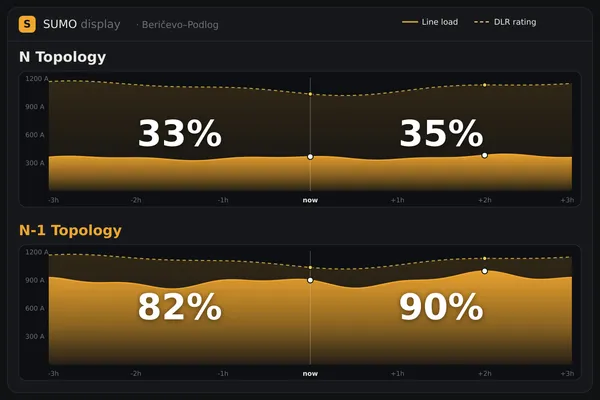
Full N and N-1 contingency awareness is built in, so operators see the impact of potential contingencies before an event occurs — a core operational capability, not a roadmap item.
Full DTR and anti-icing scope
Dynamic Transformer Rating and inverse DLR — including minimum-current calculations to prevent ice accretion — ship as native modules within the same operational environment.
Critical-infrastructure security
An industrial-grade platform for mission-critical environments, with redundant deployment architectures for SCADA-grade availability. Operato is ISO 27001 certified and SUMO is designed in alignment with IEC 62443-3-3 Security Level 3.
Rich archive and analytics
A continuous archive of every span-level input, calculation and rating feeds a built-in analytics module — the same trusted data behind trend analysis, post-event review, regulatory reporting and CAPEX justification.
How SUMO compares
Most of the market agrees DLR matters. The harder question is which approach actually works inside a control room. Here is how SUMO compares to the three approaches you will see in any procurement.
Hardware-centric DLR
Clamp-on sensors, lidar, or drone-installed devices directly monitor conductor sag, temperature and clearance. The data is good, but broad network coverage requires extensive field equipment, ongoing maintenance and significant installation effort. Adding lines means weeks of field work and outages — coverage scales with CAPEX.
Zero hardware required. Every span is calculated from the moment the system goes live, using high-resolution microscale weather modelling. New lines are added in hours through software configuration. Where a critical span warrants extra validation, third-party sensor feeds plug into the same platform.
Ratings in a portal, not in operations
A cloud weather model produces line ratings, exposed through a web portal or REST API. The integration path into SCADA/EMS, the alerting model, the N-1 logic and the security accreditation are all left to the customer's own engineering team to figure out and certify.
SCADA-native from the ground up, designed with deep operational-integration knowledge from real TSO control rooms. Ratings, alerts and operational limits flow directly into operator screens and EMS applications over standard utility protocols — not just isolated dashboards — with full N and N-1 awareness as a core capability.
Impressive demos, limited operational record
Well-funded and often credible on innovation, but typically light on the things a TSO procurement team checks last: years of live operational use, security accreditation against critical-infrastructure standards, anti-icing, dynamic transformer rating, and a verifiable list of customers running it daily.
Nine years of continuous live operation on ELES, the Slovenian TSO. ISO 27001 certified; SUMO BUS conforms to IEC 62443-3-3 Security Level 3. Production and reference deployments at HOPS, IPTO, AESO, AltaLink and PG&E. Every claim is verifiable on the ELES grid.
SUMO features
- DLR algorithm based on enhanced CIGRE model
- Full line coverage — every span
- Inverse DLR for icing prevention
- DLR results with calculated uncertainties (configurable confidence level)
- DTR for power transformers (IEC 60076)
- Extreme-weather alarms along the line
- 3 h and 56 h ratings forecasts
- 3 h and 56 h line / transformer loading forecasts
- Handles N and N-1 topologies
- Tight SCADA / EMS integration
- Archives and data export for analytics
- APIs for third-party extensions
Ten+ years of operational experience inside the ELES Group.
SUMO implementations
ELES, Slovenia
- 38 transmission lines (110 / 220 / 400 kV), 10 power transformers, 2 phase-shift transformers
- DTR ratings used automatically in day-to-day operation; operations manual updated accordingly
- Reverse DLR module used for icing prevention
See SUMO live
Book a live walkthrough of SUMO with the team, or ask about a pilot project and potential-benefit analysis.
See it live